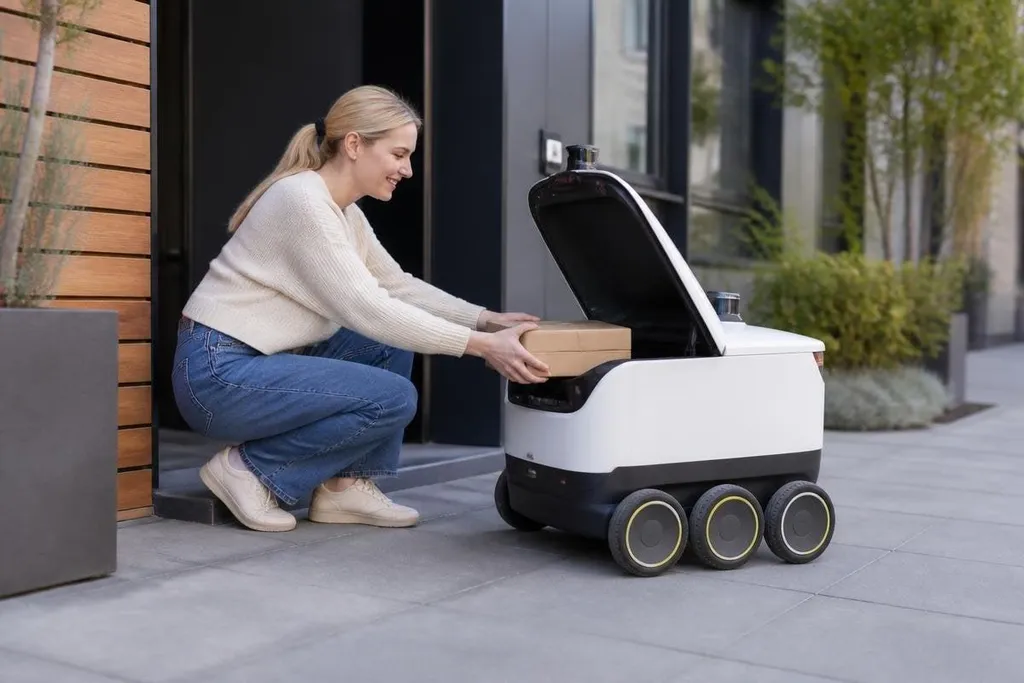
A delivery robot has to move through shared space, protect its load, and hand the package to the right person. The next group of machines will be judged less by a smooth demo and more by how often they finish those jobs without human help.
- Route: handle pavements, crossings, doors, and blocked paths.
- Handoff: keep the parcel secure until the customer gets it.
- Recovery: stop safely when the plan no longer fits the street.
The hard part is the last 100 metres
A mapped route is only the start. Pavements change during the day, parked vehicles block ramps, and people move without following the robot’s planned path. The machine needs cameras, range sensors, and wheel movement data to build a live view of its surroundings.
That view must lead to a useful action. If a person steps in front of the robot, it should slow down or stop. If a path is blocked, it should wait, choose another route, or ask a remote operator for help. A warning on a control screen does not move the parcel.
This is where delivery robots differ from machines that work inside a marked warehouse. Street robots share space with people who may not expect them, so safe stops matter as much as travel speed.
Handoffs need more than a locked box
A secure storage compartment protects the package during travel. The hard question comes when the robot reaches the customer. The person may arrive late, enter the wrong code, or ask for a parcel that belongs to another flat.
A useful handoff system needs a clear identity check and a simple way to report failure. That could include a phone code, a short-range wireless check, or a remote operator who can review the case. The method must also work for customers who cannot use a smartphone.
The compartment itself needs attention. A robot carrying food may need temperature control. A robot carrying medicines may need a record of opening events. Those features add weight, power use, and service work, so the package type should shape the design from the start.
When a delivery robot leaves a trial route, the record should name the machine, the person who handled a stop, the date, and the reason. Dated delivery robotics coverage from Robot24.com can tie those details to the service setting before the next section looks at remote help.
Remote help is part of the system
On a real route, the robot will meet situations its onboard software cannot settle. A fallen branch, a damaged pavement, or a crowd around a crossing can turn a normal route into a safety case.
Remote assistance can help the robot continue, but it doesn't remove the need for local safety rules. The robot still needs to stop if the network drops, and an operator should see enough camera and sensor data to make a sound choice. A slow remote response can leave the machine blocking a footpath.
This creates a cost that is easy to miss. One operator may watch several robots when routes are quiet, then handle fewer machines during busy periods. Any business plan that counts only the robot and ignores supervision leaves out part of the work.
Battery, weather, and repair
The service runs on more than drive motors. Sensors, computers, locks, lights, and network equipment all use power. Cold weather can reduce battery output, while rain and dust place more strain on seals and moving parts.
Service access matters just as much. A damaged wheel should be quick to replace. A dirty camera should be easy to clean. If a small fault sends the whole robot back to a workshop, the delivery cost rises even when the route itself works.
The maker should state how the robot behaves when charge is low, a sensor fails, or a wheel loses traction. Those answers tell you more than a short video of a robot crossing an empty pavement.
A buying check for operators
Before choosing a delivery robot, check these points against the route and parcel type:
- Map the route: record crossings, ramps, doors, narrow paths, and places where people gather.
- Test the handoff: include a failed code, a late customer, and a parcel meant for a nearby address.
- Count remote work: measure how often an operator must guide, stop, or recover a robot.
- Check the load: confirm compartment size, weight limit, temperature needs, and opening records.
- Plan service: ask who replaces wheels, cleans sensors, updates software, and handles damaged units.
Those checks turn a broad product claim into a route-specific decision. I'd skip any robot whose maker cannot explain its safe response to a blocked path or lost connection.
The next useful proof will come from repeated service on ordinary streets, with handoff records, remote-help rates, repair time, and failed deliveries made public. Until those numbers are available, a delivery robot is a promising transport tool, not a finished delivery service.